


An RESP can help pay for your child’s education. But what if you could also establish a lifetime financial asset that grows with them, protects their future insurability, and gives them financial flexibility well into adulthood?
Every parent wants to give their children a better start in life. We save for their education, open Registered Education Savings Plans (RESPs), put money aside in bank accounts, and make sacrifices today so that our children can enjoy more opportunities tomorrow.
But there is one financial planning opportunity that many Canadian parents overlook: The Exclusive Participating Whole Life Insurance for children.
Imagine starting a financial plan when your child is just 3 years old, contributing a manageable amount every month, and establishing permanent life insurance protection that can continue throughout their lifetime.
Now imagine that, in addition to having an RESP for university or college, your child also has a permanent insurance policy with accumulated cash value that may provide financial flexibility when they are 25, 35, 45, or even 65 years old.
This is where the exclusive participating Whole Life Insurance can play an interesting role in a family’s long-term financial strategy.
It is not about replacing your RESP, nor is it about choosing insurance instead of traditional investments. It is about building an additional financial asset that serves a different purpose.
Let’s understand how this strategy works.

1. RESP vs Whole Life Insurance: Why Should Parents Consider Both?
Before discussing Whole Life Insurance, let’s understand what an RESP does.
A Registered Education Savings Plan is one of the most attractive education savings programs available to Canadian families.
Parents contribute money to an RESP, and the government may add grants through the Canada Education Savings Grant (CESG).
For eligible children, the basic CESG provides 20% on the first $2,500 contributed annually.
That means:
Parent contributes: $2,500
Government contributes: $500
Total annual contribution and grant: $3,000
The lifetime basic CESG maximum is $7,200 per eligible child. Additional grants may be available depending on family income.
An RESP is therefore an excellent starting point for education planning.
However, an RESP is specifically designed to support qualifying post-secondary education. Its government grants and accumulated investment income are subject to rules governing withdrawals and eligible educational programs.
What happens if your child decides not to attend university?
What if your child starts a business instead?
What if they want to purchase their first home, invest in a business, or pursue an opportunity that has nothing to do with post-secondary education?
This is where a separate financial asset can provide additional flexibility.
A Whole Life Insurance policy is not restricted to education funding.
It provides permanent insurance protection and can accumulate cash value that may be accessed during the insured person’s lifetime, subject to policy terms, available values, and applicable tax rules.
Here is a simple comparison:
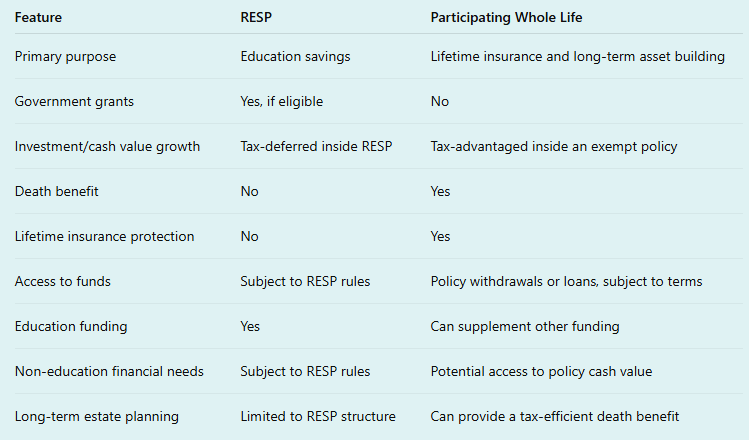
The two products serve different purposes.
My recommendation: Parents should first take advantage of available RESP grants and then consider whether their household budget allows them to establish additional long-term assets through the exclusive Participating Whole Life Insurance.
2. What Exactly Is The Exclusive Participating Whole Life Insurance?
The Exclusive Participating Whole Life Insurance is a permanent life insurance product that provides lifetime coverage and has the potential to accumulate cash value.
Unlike Term Insurance, which provides coverage for a specified period, Whole Life Insurance is designed to remain in force throughout the insured person’s lifetime, provided the policy conditions are maintained.
There are three important components.
A. Guaranteed Life Insurance Coverage
Once the policy is issued, the basic insurance amount is guaranteed, subject to the policy contract and payment of required premiums.
For a child, this means establishing permanent insurance protection at a young age.
The advantage is that the child has coverage established while they are young and, generally, before the health conditions that could affect future insurability become a concern.
B. Guaranteed Cash Value
Participating Whole Life policies have contractual guaranteed cash values that increase according to the policy’s guaranteed schedule.
This is an important distinction.
The cash value is not simply the amount of premiums deposited into a bank account. Part of the premium pays for insurance protection, policy expenses, and other costs.
The guaranteed cash value develops according to the policy contract.
C. Potential Dividends and Additional Cash Value
Participating policies may receive dividends when declared by the insurance company.
These dividends are not guaranteed.
Depending on the selected dividend option, they may be used to:
Purchase additional paid-up insurance.
Increase the policy’s cash value.
Increase the future death benefit.
Reduce premiums.
Be paid in cash or left on deposit, depending on the product.
When dividends purchase additional paid-up insurance, the policy can accumulate additional insurance coverage and cash value over time.
This creates the possibility of long-term growth beyond the guaranteed values.
Remember: the guaranteed values and illustrated dividend-based values must always be presented separately.
3. Why Starting at Age 3, 7 or 10 Can Make a Difference
This is probably the most important concept parents need to understand.
Time is one of the biggest advantages in a child’s financial planning strategy.
When a Whole Life policy is established at a young age, the insurance company calculates the premium based on the child’s age, underwriting classification, selected coverage, and product design.
Generally, younger insured individuals can qualify for lower premiums for a given amount of permanent coverage.
There is also a longer period for the policy’s guaranteed cash values and potential dividends to accumulate.
Consider three children:
Child A: Age 3
Child B: Age 7
Child C: Age 10
If all three start comparable policies today, they will have different starting ages and different premium requirements.
The youngest child has the longest time horizon.
For example, after 20 years:

Although all three policies have been in force for 20 years, the youngest child started earlier and generally benefited from lower age-based insurance pricing.
There is another important consideration.
If the objective is to have a policy fully paid up before the child enters adulthood, starting earlier makes the timeline more favourable.
For a 20-Pay policy:
Start at age 3: Premium payments finish around age 23.
Start at age 7: Premium payments finish around age 27.
Start at age 10: Premium payments finish around age 30.
The actual premium and projected values must be illustrated separately for each child.
The earlier you start, the more time you give the policy to develop.
4. A Real Illustration: What Can a $100 Monthly Budget Establish?
Let’s consider an actual illustration prepared for a female child aged 3 in Ontario.
The illustration was prepared using an exclusive participating Whole Life Insurance.
Here are the important figures:
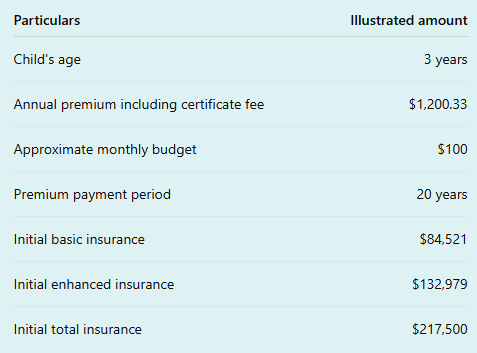
This means the family is establishing approximately $217,500 of initial life insurance coverage for a child aged just 3.
The premium-paying period is 20 years.
After the scheduled 20-year premium-paying period, the illustrated policy is paid-up for its principal coverage, subject to the policy contract and any applicable additional benefits.
The policy continues to provide permanent insurance protection.
What could the policy values look like?
The following figures are taken from the supplied exclusive illustration.
Important: The guaranteed cash value and the total cash value based on the current dividend scale are different. The latter is a projection, not a promise.
At age 23, after the scheduled 20-pay period, the illustration shows:
Guaranteed cash value: $3,903.
Total illustrated cash value: $10,311.
Guaranteed insurance amount: $217,500.
The potential long-term value becomes more interesting as the policy matures.
At age 65, the illustration shows approximately $123,620 of total cash value based on the current dividend scale.
At age 80, it shows approximately $297,376.
At age 100, it shows approximately $584,190.
These are illustrated values under the assumptions in the original illustration. Actual future dividends and cash values may be higher or lower.
The important point is not to promise parents that their child will have a particular amount of money at age 100.
The important point is to demonstrate how a relatively modest premium commitment can establish permanent insurance protection and a long-term cash value asset.
5. Why The Exclusive Participating Whole Life Deserves Attention
When comparing participating Whole Life products, parents should look beyond the initial death benefit and projected cash value.
The additional contractual and membership benefits can also make a difference.
In the exclusive illustration supplied, there are several features worth discussing.
A. Charity Benefit
This company’s exclusive PAR WL includes a Charity Benefit provision.
Under the product provision, when an eligible death claim is paid, an additional amount equal to 1% of the basic insurance amount, up to $100,000, may be paid to an eligible registered charitable organization designated by the owner.
There is no additional premium for this provision.
This is an interesting way to introduce children to charitable giving and the importance of contributing to society.
B. Children’s Insurance Benefit
The Exclusive Participating Whole Life includes a Children’s Insurance Benefit that provides $3,000 of term insurance on each eligible insured child until age 25.
Subject to the product provisions, the child may have an opportunity during specified periods to convert that coverage to permanent insurance and purchase additional permanent coverage without providing evidence of insurability.
This is particularly interesting for families with more than one child.
C. Juvenile Guaranteed Insurability Benefit
One of the most valuable considerations when insuring a child is future insurability.
The Juvenile Guaranteed Insurability Benefit provides opportunities to purchase additional insurance at specified option dates without new evidence of insurability, subject to the contractual provisions.
Why does this matter?
A child may grow up to become a doctor, entrepreneur, professional athlete, business owner, or employee.
Their financial responsibilities will change as they get older.
They may eventually need more life insurance protection because of a mortgage, family responsibilities, business ownership, or other financial commitments.
Having guaranteed opportunities to obtain additional coverage can be valuable if their health changes.
D. Teladoc Medical Experts
The product also provides access to Teladoc Medical Experts, subject to eligibility requirements and program terms.
The insured individual and certain eligible family members may access medical expertise and second-opinion services.
This is a useful additional service to explain to parents, although it should not be confused with a separate health insurance policy.
E. Additional Policy Options
The product offers other options and riders, depending on eligibility and the selected policy design.
These can include:
Additional Purchase Option.
Guaranteed Insurability Rider.
Waiver of Premium Rider.
Children’s Term Insurance Rider.
Accidental Death Rider.
Term Insurance Riders.
Not every feature is automatically included. Some require additional premiums, and eligibility and availability must be confirmed.
The key takeaway is that parents should assess the complete policy package, rather than looking only at the initial coverage amount.
6. How Can Whole Life Insurance Complement an Existing RESP?
Let’s look at how a family could structure its financial planning.
Imagine a family with three children.
The parents already contribute to an RESP but would also like to establish a separate financial asset for each child.
Their financial planning could look like this:
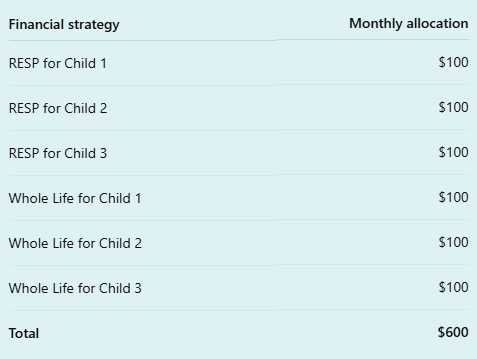
This is simply an illustrative family budget, not a recommended contribution level for every household.
The parents can adjust the allocations according to their income, debt obligations, emergency savings, retirement needs, and existing insurance coverage.
The purpose is to build two different financial foundations.
RESP: The Education Bucket
The RESP is intended to support qualifying post-secondary education.
It benefits from tax-deferred investment growth and potentially government grants.
It should generally be prioritised to capture available CESG benefits.
The Exclusive Participating Whole Life: The Lifetime Financial Asset
The Whole Life policy serves a different purpose.
It provides permanent insurance protection and the potential to accumulate cash value over time.
When the child becomes an adult, the policy may provide additional financial flexibility through withdrawals or policy loans, subject to policy provisions and tax implications.
The child may eventually use other financial resources for education, while the policy remains in force.
This is why I consider the two products complementary rather than competing financial strategies.
7. What Could Your Child Do With the Policy in Adulthood?
This is where the conversation becomes more interesting for parents.
Instead of looking at the policy only as a children’s insurance product, consider what it could mean when the child becomes financially independent.
Scenario 1: Starting a Business
Imagine your child becomes an entrepreneur at age 30.
They may need capital to start a business, purchase equipment, or manage working capital.
Depending on the policy’s accumulated cash value, they may have the option of accessing funds through a policy withdrawal or loan.
This could provide an additional source of financing.
However, the available amount, interest cost, tax consequences, and impact on the death benefit must be evaluated before accessing the policy.
Scenario 2: Buying a First Home
Your child may eventually want to purchase their first home.
The accumulated policy value could potentially provide another financial resource.
A policy loan or withdrawal may be considered, but it should be compared against other borrowing options, including a mortgage, FHSA, or other savings.
It is important not to assume that policy cash value will necessarily be large enough to fund a down payment.
Scenario 3: Supporting Family Responsibilities
At age 35 or 40, your child may have a spouse, children, mortgage, and other responsibilities.
The permanent insurance protection established during childhood can continue to provide a death benefit.
They may also have the opportunity to increase their coverage through applicable guaranteed insurability provisions.
Scenario 4: Supplementing Retirement Planning
At age 60 or 65, the policy may have accumulated substantial cash value.
Depending on the policy design and available values, the owner could explore policy loans or withdrawals as an additional source of retirement liquidity.
This should be coordinated with other retirement assets and professional tax advice.
The objective is not to replace an RRSP, TFSA, CPP, or other retirement savings.
It is to have another potential financial resource available.
8. What Happens If the Child Does Not Attend University?
This is one of the most important differences parents should understand.
An RESP is designed to support post-secondary education.
If the child does not pursue qualifying education, the treatment of the RESP depends on the plan’s circumstances and applicable rules.
Generally:
Contributions can be returned to the subscriber tax-free.
Government grants may need to be returned.
Accumulated investment income may be subject to accumulated income payment rules, including regular income tax and an additional 20% tax (12% for Quebec residents), subject to applicable exceptions and rollover provisions.
Whole Life Insurance operates differently.
It is not dependent on the child attending university, college, or a trade school.
The policy can continue to provide insurance protection and accumulate cash value regardless of the child’s educational decisions.
For parents, this creates an additional planning option.
Their child’s future is not limited to one educational or career path.
9. Is the Cash Value Tax-Free?
This is an important question, especially for financially sophisticated parents.
In Canada, qualifying exempt life insurance policies receive special tax treatment.
The investment income accumulating inside an exempt life insurance policy is generally not subject to annual policyholder taxation while it remains within the policy and the applicable exempt-policy limits are respected.
However, this does not mean every dollar can be withdrawn tax-free.
There are important differences between:
Cash withdrawals.
Policy loans.
Policy surrender.
Dividends paid directly to the policyholder.
Death benefit payments.
A withdrawal or surrender can result in taxable income depending on the policy’s adjusted cost basis (ACB) and proceeds.
Policy loans can also trigger a taxable policy disposition in certain circumstances.
The death benefit paid to beneficiaries is generally received tax-free for Canadian income tax purposes, subject to the applicable rules.
A professional review of the policy’s ACB and tax consequences is essential before accessing the cash value.
This is particularly important if the policy is intended to be used as a long-term financial planning asset.
10. What If Parents Wait Until Their Children Are Older?
This is another important conversation.
Many parents postpone financial planning because they believe they have plenty of time.
But waiting has consequences.
For Whole Life Insurance, the insured child’s age is an important factor in determining the premium required for a particular amount of coverage.
Consider a 20-Pay policy.

A child starting at age 3 has the opportunity to complete the premium-paying period before reaching their mid-twenties.
A child starting at age 15 would not complete the same premium-paying period until age 35.
There is also a difference in the premium required for comparable insurance coverage.
The younger the insured, generally the lower the premium for the same amount of permanent insurance, assuming comparable underwriting and product design.
However, it is important to avoid making unsupported assumptions about future cash values.
To demonstrate the actual financial impact of waiting, an advisor should prepare separate illustrations for each starting age using:
The same insurance company.
The same product.
The same dividend option.
The same premium-paying period.
Comparable insurance coverage.
The same dividend scale assumptions.
Then parents can see how the numbers change.
11. What Should Parents Consider Before Purchasing?
Whole Life Insurance is a long-term financial commitment.
It is not suitable for every family.
Before recommending a policy, I would encourage parents to consider the following.
A. Have You Established an Emergency Fund?
Parents should have sufficient accessible savings for unexpected expenses.
They should not commit money to a long-term insurance contract if doing so could compromise their household financial security.
B. Are You Maximising Your RESP Opportunities?
Parents should understand the available CESG benefits and contribution room.
It is generally sensible to evaluate the available government education grants before allocating additional money to other financial products.
C. Do You Have Adequate Life Insurance Yourself?
Parents are usually the primary financial providers.
If something happens to a parent, the family’s immediate financial security may be more important than the child’s policy.
Parents should assess their own life insurance, disability protection, and critical illness coverage.
D. Can You Afford the Premium for 20 Years?
A 20-Pay policy requires a long-term commitment.
Parents should be comfortable making the scheduled payments without sacrificing their other financial responsibilities.
Cancelling a policy early may result in receiving significantly less than the total premiums paid.
E. Do You Understand Guaranteed vs Non-Guaranteed Values?
This is critical.
The guaranteed values are contractual.
The dividend-based projections depend on future dividend scales, which can change.
Parents should always review alternate dividend scenarios before making a decision.
12. My Financial Planning Recommendation: Build Two Financial Foundations
If I were sitting with parents who have children aged 3, 7, and 10, I would approach the conversation differently.
I would not start by showing them a $200,000 death benefit or a projected cash value of several hundred thousand dollars.
I would start by understanding their family’s financial goals.
I would ask:
Have you already established an RESP for each child?
Are you contributing enough to receive the available government grants?
Do you have an emergency savings fund?
Do you have adequate personal life insurance?
Would you like to establish a separate long-term financial asset for each child?
Would a manageable monthly premium fit into your household budget for the next 20 years?
Once these questions are answered, I would prepare a comparison of suitable Whole Life products.
I would show parents:
The initial insurance coverage.
The annual and monthly premium.
Guaranteed cash values.
Non-guaranteed cash values.
Projected death benefits.
Alternative dividend scenarios.
Additional contractual benefits.
The effect of starting at different ages.
Most importantly, I would demonstrate the difference between starting at age 3, 7, and 10.
Parents should be able to make an informed decision rather than feeling pressured into purchasing an insurance product.
13. The Bigger Picture: What Financial Legacy Are You Building for Your Children?
Think about this for a moment.
When your child is 3 years old, you are making decisions on their behalf.
You decide where they go to school, what activities they participate in, and how much money you put aside for their future.
But there is another decision worth considering.
What financial foundation would you like them to inherit?
Imagine your child turning 23.
They have completed their education, started their career, and are beginning to build their own financial future.
They may already have an RESP that helped fund their education.
They may also have a permanent life insurance policy that was established two decades earlier.
The scheduled premiums have been completed, the insurance protection continues, and the policy has had years to accumulate cash value.
At that point, the policy is no longer simply something their parents purchased when they were young.
It is an asset they can continue to maintain as part of their own financial plan.
They may eventually use it as part of their estate planning, family protection, business planning, or long-term financial strategy.
That is the bigger picture.
You are not simply purchasing an insurance policy for your child. You are establishing a financial foundation that can potentially stay with them for generations.
Additional Membership Benefits – More Than Just Life Insurance
One of the lesser-known advantages of this whole life plan is access to a range of membership benefits that extend beyond the insurance policy itself. These programs can provide educational assistance, family support, legal-document preparation, savings on everyday purchases and opportunities to participate in community activities.
1. Orphan Benefit – Financial Support for Children
If both parents pass away, eligible children may qualify for a monthly payment of up to $900 per child.
This benefit can help provide some financial stability for children during an extremely difficult period. Eligibility requirements and program conditions apply.
2. Orphan Scholarships – Support for Higher Education
Eligible children of deceased members may qualify for renewable post-secondary education scholarships of up to $6,000 per year for four years.
That represents potential scholarship support of up to $24,000 per eligible child, helping families manage future education expenses.
3. LawAssure – Online Legal Document Preparation
Members can access complimentary online preparation of customizable legal documents, including:
Wills
Powers of Attorney
Healthcare Directives
Having these documents prepared can help families organize important legal and personal affairs and make their wishes clearer.
4. Terminal Illness Loan – Access to Financial Support
Eligible members diagnosed with a terminal illness may qualify for an interest-free loan of up to 75% of the face value of their life insurance.
This may provide access to financial resources when they are needed most. The loan is subject to eligibility and program conditions and is separate from the policy’s regular cash-value features.
5. Competitive Scholarship Program
Eligible members and their family members pursuing post-secondary education may apply for scholarships.
The current program advertises awards of up to $2,500, with academic performance and community-service requirements.
6. Foresters Renew – Education and Career Development Assistance
Members may qualify for reimbursement grants for eligible education and career-development expenses, including:
Tuition and course fees
Textbooks
Learning tools
The current 2026 program advertises reimbursement of up to $1,000, subject to eligibility and available funding.
7. Community Grants – Family Activities and Experiences
Members may have opportunities to receive grants to organize family activities and experiences, such as:
Museum visits
Theme parks
Cooking classes
Other recreational activities
These grants encourage families to spend quality time together and enjoy shared experiences.
8. Volunteer Grants – Giving Back to the Community
Members involved in eligible volunteer activities may receive financial support for initiatives benefiting registered charities and not-for-profit organizations.
Examples include food-bank donations, care kits and community gardens.
9. Care Grants – Supporting Local Causes
Eligible members aged 18 or older can apply for two grants of $200 each per year, potentially providing up to $400 annually to support local community causes.
10. Member Discounts – Everyday Savings
Members can access discounts on a variety of everyday purchases and experiences, including:
Electronics, clothing and jewellery
Vision care
Hotels and rental cars
Theme parks and attractions
Movie tickets and family entertainment
These discounts can provide additional value to members beyond their life insurance coverage.
11. Member Governance and Leadership Development
Members can participate in local branches, connect with other volunteers and develop leadership skills.
There may also be opportunities to attend an annual Leadership Development Conference, providing a chance to build connections and participate in community leadership activities.
12. Membership Matters Newsletter
Members can receive an online newsletter featuring information and articles on topics such as:
Healthy living
Online security
Financial wellness
Other relevant member interests
This provides an additional channel for members to stay informed about useful resources and initiatives.
An Important Note About Membership Benefits
These membership programs are separate from the guaranteed contractual benefits of the life insurance policy. They are subject to eligibility requirements, program rules, funding availability and changes made by the organization. Not every member or family member will necessarily qualify for every benefit.
The availability and current terms should be confirmed before relying on any particular benefit.
Finally: The Best Time to Start Planning Is When You Can Afford to Start
There is no single financial product that can meet every family’s needs.
RESPs, TFSAs, FHSAs, RRSPs, investment portfolios, and Whole Life Insurance all serve different purposes.
The smartest approach is to understand how these financial tools can work together.
For parents who have already started saving for their children’s education, participating Whole Life Insurance may provide an additional opportunity to establish permanent protection and long-term financial value.
And if you have more than one child, it is worth examining each child’s situation separately.
A child aged 3 has a different financial planning horizon from a child aged 10.
The earlier you explore the options, the more flexibility you may have in designing a suitable long-term plan.
Your children may not remember the financial decisions you make for them today. But the financial foundation you establish could benefit them for the rest of their lives.
Want to Explore a Whole Life Insurance Plan for Your Child?
If you are a parent in Canada and already have an RESP, perhaps it is time to look at what else you could establish for your children’s financial future.
I can help you understand:
How participating Whole Life Insurance works.
How much coverage could be established within your monthly budget.
How different insurance companies compare.
What guaranteed and projected cash values look like.
How starting at a younger age can change the long-term illustration.
How Whole Life Insurance can complement your existing RESP and broader financial plan.
There is no obligation to purchase a policy. The objective is to understand your options and make an informed financial decision.
Let’s start building a stronger financial foundation for the next generation.
Serving families across Canada.