


You worked hard to reach a six-figure income. You invested years in your education, career, business and professional development. You may now be earning $175,000, $200,000, $250,000 or even more annually.
But here is an important question:
Are you managing your income strategically, or are you simply allowing a substantial portion of your hard-earned money to disappear through income taxes every year?
If you are a high-income professional, business owner, senior executive, consultant, specialist physician, dentist, lawyer or self-employed individual in Canada, there is a good chance that you are paying a significant amount of income tax.
And this is where your Registered Retirement Savings Plan (RRSP) can become one of your most valuable financial planning tools.
However, simply contributing to an RRSP every year does not necessarily mean you are using it wisely.
The real opportunity lies in understanding:
When to contribute.
How much to contribute.
When to claim your RRSP deduction.
How to coordinate your RRSP with your TFSA.
How to use a Spousal RRSP.
How to structure your retirement withdrawals.
How to avoid paying unnecessary taxes both today and in retirement.
Let’s explore how you can turn your RRSP into a more effective tax-planning and wealth-building strategy.
1. Why Earning $175,000 or More Changes Your Tax Planning Strategy
When your income increases, your tax-planning opportunities become increasingly important.
Canada uses a progressive income tax system. This means that different portions of your income are taxed at different rates.
You do not pay your highest marginal tax rate on every dollar you earn. Instead, only the portion of income falling into a particular tax bracket is taxed at that bracket’s rate.
For example, someone earning $175,000 does not pay the same tax rate on their first $50,000 as they do on their last $25,000.
This distinction is extremely important when planning RRSP contributions.
Understanding Marginal Tax Rates
Your marginal tax rate represents the amount of tax you pay on your next dollar of taxable income.
For a high-income earner, an additional dollar of income can attract a substantial combined federal and provincial tax rate.
Consider Ontario as an example.
Under the 2026 tax brackets, the approximate combined marginal tax rates, including Ontario surtax, are:
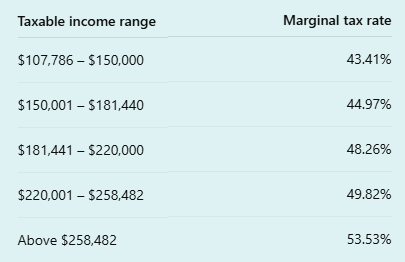
These are illustrative 2026 Ontario rates for ordinary employment income, not universal Canadian rates. Your province or territory of residence makes a difference.
Now consider someone earning $200,000 in Ontario.
A portion of their income falls into a marginal tax bracket of approximately 48.26%.
This means that, subject to the applicable tax calculations, every additional $1,000 of taxable income within that bracket could attract approximately $483 in income tax.
That is why RRSP planning deserves serious attention when your income reaches these levels.
Why the $175,000 Income Level Matters
There is nothing magical about $175,000.
However, for many professionals, this income level represents a point where a combination of higher marginal tax rates, retirement planning and investment decisions can make tax planning particularly valuable.
The objective should not simply be to reduce this year’s income tax.
It should be to determine whether you can pay less tax over your entire lifetime by strategically managing when your income is taxed.
