


Having a new born in the family is one of life’s most beautiful experiences. However, it also brings significant financial changes and responsibilities. Household expenses increase, regular employment income may decrease, and parents suddenly find themselves managing their finances on a different budget.
For many Canadian mothers, maternity and parental leave means relying on Employment Insurance (EI) benefits instead of their regular employment salary.
Imagine a mother who was previously earning $60,000, $70,000 or even $80,000 annually but is now receiving approximately $600 per week in maternity and parental benefits.
Her immediate concern might be:
Will I have to pay income tax on my maternity benefits?
Why is the government deducting tax from my weekly EI payments?
Will I receive a tax refund when I file my income tax return?
Should I contribute to my RRSP while I am on maternity leave?
How much should I contribute to minimize my income tax?
Can I use my RRSP contribution to increase my Canada Child Benefit (CCB)?
These are excellent questions, and the answers can make a meaningful difference to a family’s financial situation.
The good news is that proper tax planning, particularly through an appropriate RRSP contribution and deduction strategy, may help reduce your income tax, increase your tax refund and potentially improve certain income-tested government benefits.
However, there is an important distinction: contributing money to an RRSP and claiming an RRSP deduction are two different decisions. Understanding this distinction is particularly important for mothers who have temporarily stopped receiving their regular employment income.
Let’s explore how this works under Canadian tax rules.
1. Understanding Maternity and Parental Benefits in Canada
Before discussing RRSP contributions, it is important to understand how maternity and parental benefits are treated under Canadian tax laws.
In Canada, eligible working mothers may receive Employment Insurance maternity benefits and parental benefits through Service Canada.
These benefits are designed to provide temporary financial assistance when parents take time away from work to care for a newborn or newly adopted child.
There are two main types of benefits.
Maternity Benefits
Maternity benefits are available exclusively to the person who is pregnant or has recently given birth.
Under the federal EI program:
Maternity benefits can be received for up to 15 weeks.
The benefit rate is generally 55% of average insurable weekly earnings.
A maximum weekly benefit applies.
Parental Benefits
Parental benefits are available to parents caring for a newborn or newly adopted child.
There are two options:

The standard option generally provides a higher weekly payment over a shorter period, whereas the extended option provides lower weekly payments over a longer period.
Parents may share parental benefits, subject to the applicable eligibility and maximum-week rules.
For 2026 claims, the maximum weekly benefit is $729 for maternity and standard parental benefits and $437 for extended parental benefits.
Important: The amount of approximately $600 per week in our example is the client’s actual weekly benefit, not necessarily the maximum benefit available.
2. Are Maternity and Parental Benefits Taxable in Canada?
Yes – Fully Taxable Income
One of the most common misconceptions among new mothers is that maternity and parental benefits are tax-free because they are government assistance payments.
This is incorrect.
Employment Insurance maternity and parental benefits are taxable income under Canadian income tax rules.
This means that the amount received during maternity or parental leave must be reported on the individual’s annual income tax return.
How Are These Benefits Reported?
Service Canada generally issues a T4E slip showing the EI benefits received during the calendar year.
The information is reported on:
Line 11900: Employment insurance and other benefits.
Line 11905: Employment insurance maternity and parental benefits and certain related amounts, where applicable.
The applicable amounts and reporting instructions should be checked against the T4E slip.
For example, consider a mother receiving $600 per week.
Particulars
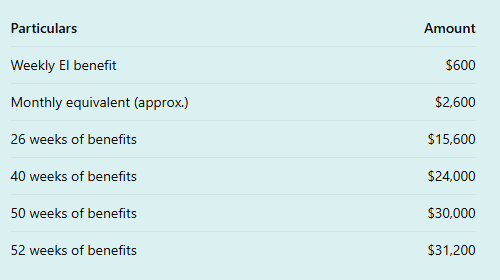
These amounts represent gross benefits before any income tax withholding.
Is Income Tax Automatically Deducted?
Yes. Service Canada generally deducts income tax from EI payments.
However, the amount deducted may not accurately reflect the individual’s final annual tax liability.
For example, a mother might have worked for six months, received maternity benefits for the remaining six months and had income tax deducted from both her employment salary and EI payments.
When she files her annual tax return, CRA calculates her actual tax liability based on her combined annual income, eligible deductions and tax credits.
This can result in:
A tax refund if too much income tax was deducted.
A balance owing if insufficient income tax was deducted.
Little or no refund if the tax withheld closely matches her final tax liability.
The important lesson: Receiving $600 per week does not mean that the entire amount is tax-free or that the government will automatically issue a tax refund.
3. Why a Mother on Maternity Leave May Have an Opportunity to Save Income Tax
Here is where tax planning becomes interesting.
Imagine a mother who was earning $70,000 annually before taking maternity leave.
She worked for six months and then received approximately $600 per week in EI maternity and parental benefits for the rest of the year.
Her annual income may look something like this:

Instead of earning $70,000 throughout the year, her actual annual income is approximately $50,600.
This reduction in annual income can create an opportunity to make a strategic RRSP contribution.
Why?
Because Canada’s income tax system is progressive. Different portions of taxable income are subject to different marginal tax rates.
When a person’s annual income decreases, some income may fall into lower tax brackets.
An RRSP contribution can further reduce taxable income, potentially reducing the amount of income tax payable.
However, the benefit depends on the individual’s complete tax situation.
The RRSP Opportunity
Suppose this mother has $20,000 of unused RRSP deduction room.
She could potentially contribute an amount to her RRSP and claim an eligible deduction to reduce her taxable income.
For example:

The $5,000 RRSP deduction reduces her income used in calculating taxable income.
This could lower her income tax liability and increase her refund, depending on the tax already deducted at source and other credits and deductions.
But should she contribute $5,000, $10,000 or $15,000?
That is where an individualized tax calculation becomes important.
4. How Much Should You Contribute to Your RRSP?
This is probably the most important question for a mother receiving maternity or parental benefits.
There is no universal RRSP contribution amount that works for everyone. The ideal amount depends on several factors:
Total employment income earned during the year.
Total maternity and parental benefits received.
Other income, including investment or rental income.
Available RRSP contribution room.
Income tax already deducted from employment income and EI benefits.
Other deductions and non-refundable tax credits.
Whether the individual expects to return to work at a higher income next year.
The objective should not simply be to contribute as much as possible.
Instead, the objective should be to identify an RRSP contribution that provides a worthwhile tax deduction without unnecessarily sacrificing cash needed for the family.
Step 1: Calculate Total Annual Income
Start by calculating all taxable income received during the calendar year.
For example:

This is the starting point for determining the individual’s tax position.
Step 2: Check Available RRSP Contribution Room
Before making any contribution, check the RRSP deduction limit on the latest Notice of Assessment or through CRA My Account.
The contribution room is generally based on:
Unused RRSP room carried forward from previous years.
18% of the previous year’s eligible earned income, subject to the annual limit.
Applicable pension adjustments and other prescribed adjustments.
An important detail is that EI maternity and parental benefits are not employment or self-employment earned income for the purpose of generating new RRSP contribution room.
Therefore, receiving $30,000 in maternity and parental benefits does not automatically create $5,400 of new RRSP contribution room.
The client should rely on the RRSP deduction limit provided by CRA rather than calculating room based on her current EI income.
For 2026, the annual RRSP dollar limit is $33,810, but an individual’s actual available contribution room may be substantially lower.
Step 3: Calculate the Potential RRSP Deduction
Once the available RRSP room is established, calculate different possible contribution scenarios.
For example:

These figures are simplified illustrations before considering other deductions.
A tax preparation professional can calculate the actual federal and provincial tax savings under each scenario.
My recommendation: Do not automatically select the largest contribution. Compare the tax savings from each additional dollar contributed and consider whether the deduction would be more valuable in a future year when the mother returns to full-time employment.
5. An Important Strategy: Contribute Now, Claim the Deduction Later
Here is something many Canadian taxpayers do not realize.
You do not necessarily have to claim your RRSP contribution as a deduction in the same tax year in which you make the contribution.
This is one of the most useful features of RRSP tax planning.
Under CRA rules, eligible RRSP contributions can be reported in the year they are made, but the deduction can be deferred and claimed in a future tax year, subject to the applicable rules and available deduction limit.
This creates an opportunity for mothers who are temporarily earning less income during maternity leave.
How Does This Work?
Suppose a mother has:
Annual income of $54,000.
Available RRSP contribution room of $15,000.
Plans to return to work next year at an annual salary of $75,000.
She decides to contribute $10,000 to her RRSP while on maternity leave.
She now has two broad choices:
Option A: Claim the full $10,000 deduction immediately.
This reduces her income for the current tax year and may generate a larger refund.
Option B: Claim only part of the deduction and carry forward the unused eligible deduction.
For example, she might claim $3,000 this year and carry forward the remaining $7,000 for a future year when she is earning a higher salary.
The second option may produce greater overall tax savings if her future marginal tax rate is higher.
However, this does not mean that deferring the deduction is always better. The tax savings depend on the difference between her current and future marginal tax rates, the time value of money and other benefit calculations.
Why Is This Strategy Useful?
Consider a mother returning to work in the following year.
During maternity leave, her annual income might be $45,000.
After returning to work, she may earn $75,000.
A deduction claimed against $75,000 of income could generate greater tax savings than the same deduction claimed against $45,000, depending on the applicable federal and provincial tax brackets.
The contribution can be made while the mother is on leave, provided she has sufficient contribution room. The deduction can then be strategically allocated to a suitable tax year.
6. Real-Life Example:
A Mother Receiving $600 Per Week
Let’s examine a practical example to understand how RRSP planning could work.
Assume the following circumstances:
The mother lives in Ontario.
Her previous annual employment salary was $72,000.
She worked for six months.
She received $600 per week in maternity and parental benefits.
She received approximately 26 weeks of EI benefits.
She has $12,000 of available RRSP deduction room.
She has no other significant income.
Her income would look like this:
Annual income calculation
Employment income = $36,000
EI benefits (26 × $600) = $15,600
Total annual income = $51,600
Now let’s consider three RRSP deduction scenarios.

The actual tax liability would be calculated after applying the relevant federal and Ontario tax rules, eligible credits and other deductions.
What Is the Potential Benefit?
Without an RRSP deduction, the mother’s tax return is calculated using her $51,600 of income, adjusted for applicable deductions and credits.
With a $5,000 RRSP deduction, her taxable income is reduced.
With a $10,000 deduction, her taxable income is reduced further.
This can potentially:
Reduce federal income tax.
Reduce Ontario income tax.
Increase the refund if sufficient tax was withheld during the year.
Reduce net income used in certain income-tested benefit calculations.
However, an RRSP deduction does not create a refund equal to the contribution.
For example, contributing $5,000 does not mean CRA will refund $5,000.
The tax savings are generally related to the applicable marginal tax rates and the individual’s overall tax position.
Also, if the mother has very little tax payable because her annual income is relatively low, contributing a large amount solely to obtain a current-year refund may not be the most efficient strategy.
7. Can an RRSP Contribution Increase Your Canada Child Benefit (CCB)?
An Important Additional Benefit
This is one of the most interesting aspects of RRSP planning for new parents.
Many families focus exclusively on their income tax refund and overlook the potential impact of RRSP deductions on the Canada Child Benefit.
The Canada Child Benefit is a tax-free monthly payment administered by CRA to help eligible families with the cost of raising children.
The amount a family receives depends on several factors, including:
Number of eligible children.
Age of the children.
Adjusted family net income (AFNI).
Applicable benefit-year rules.
How Does RRSP Planning Affect CCB?
CRA generally calculates adjusted family net income using the combined net income of both spouses or common-law partners, subject to specified adjustments.
An RRSP deduction reduces the contributor’s net income reported on Line 23600.
Consequently, it can reduce the family’s adjusted family net income.
If the family is in a CCB reduction range, reducing adjusted family net income may increase the amount of CCB payable in a subsequent benefit period.
Let’s look at a simplified illustration.

The $5,000 RRSP deduction reduces the family’s income used in the CCB calculation by $5,000, assuming no other adjustments.
The actual CCB increase depends on the family’s income level, number of children and applicable benefit-year thresholds.
Important: A $5,000 RRSP deduction does not guarantee a particular increase in monthly CCB. If the family’s income is already below the applicable threshold where the maximum benefit is payable, the deduction may not increase CCB further.
When Will the CCB Increase?
CCB is generally recalculated every July using the family’s income reported for the previous calendar year.
For example:
2026 income tax return: reports 2026 income and deductions.
July 2027: the CCB payment period generally starts using the 2026 family income information.
Therefore, an RRSP deduction claimed on the 2026 tax return may help increase CCB payments from July 2027 onward.
8. Does a Mother Have to Repay EI Benefits If Her Income Is High?
Another common concern is whether receiving maternity and parental benefits can result in an EI clawback.
There is an important distinction here.
Under the EI benefit repayment provisions, certain individuals receiving regular EI benefits may have to repay some benefits if their net income exceeds the applicable threshold.
However, maternity and parental benefits are classified as special EI benefits and are exempt from this particular EI benefit repayment provision.
This means a mother does not have to repay maternity or parental EI benefits simply because her annual income exceeds the regular EI repayment threshold.
For example, if a mother:
Received $15,600 in maternity and parental benefits.
Earned $60,000 in employment income.
Had additional investment income.
She would still be exempt from the EI repayment provision applicable to regular EI benefits, provided the payments were maternity and parental special benefits.
This is an important distinction because some taxpayers mistakenly assume that all EI benefits are subject to the same repayment rules.
However, remember that the maternity and parental benefits remain taxable income. Being exempt from EI benefit repayment does not mean being exempt from income tax.
9. Should You Contribute to Your Own RRSP or Your Spouse’s RRSP?
For families where one spouse earns substantially more than the other, another tax-planning opportunity may be available through a spousal RRSP.
A spousal RRSP is an RRSP registered in the name of one spouse or common-law partner, but the other spouse makes the contribution.
For example:
Wife is on maternity leave and earning $25,000.
Husband is working full-time and earning $100,000.
Wife has sufficient RRSP deduction room.
Husband wants to help build retirement savings for the family.
The husband may contribute to his wife’s spousal RRSP, provided the contribution is within his own available RRSP deduction limit.
What Are the Advantages?
A spousal RRSP can help balance retirement savings between spouses.
It can also provide income-splitting opportunities in retirement, subject to the attribution rules.
For example, if one spouse has accumulated significantly more retirement savings, a spousal RRSP may help build retirement assets in the lower-income spouse’s name.
However, there is an important rule.
The person making the contribution generally claims the RRSP deduction, not the spouse who owns the account.
For instance, if the husband contributes $5,000 to his wife’s spousal RRSP:
The husband claims the eligible $5,000 RRSP deduction.
The wife owns the RRSP.
The contribution uses the husband’s RRSP deduction room.
There are also attribution rules to consider. Generally, withdrawals from a spousal RRSP can be attributed back to the contributing spouse if the withdrawal occurs in the contribution year or either of the two preceding calendar years, subject to the applicable rules.
My recommendation: Consider a spousal RRSP as part of a longer-term family retirement strategy rather than treating it as an automatic solution for a mother on maternity leave.
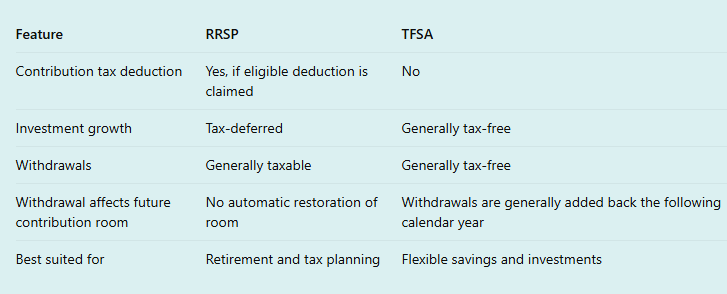
10. RRSP Versus TFSA: Which Is Better During Maternity Leave?
An RRSP is not necessarily the best savings option for every mother.
In some situations, a Tax-Free Savings Account (TFSA) may be more suitable.
Understanding the difference is important.
When an RRSP May Be Better
An RRSP may be attractive when:
The mother has sufficient contribution room.
Her current marginal tax rate is relatively high.
She expects to earn less in retirement.
She can afford to leave the money invested.
She wants to reduce current or future taxable income strategically.
When a TFSA May Be Better
A TFSA may be more appropriate when:
The mother’s annual income is already relatively low.
She expects to return to a higher-paying job.
She may need access to the money for childcare or household expenses.
She does not have sufficient RRSP contribution room.
She wants flexibility without creating taxable withdrawals.
Remember that withdrawing money from an RRSP generally creates taxable income, whereas qualifying TFSA withdrawals are tax-free.
For a new mother managing childcare expenses, mortgage or rent payments and other family commitments, maintaining accessible savings can be more important than obtaining a small immediate tax refund.
A good financial plan should balance tax savings with financial security.
11. Common Mistakes to Avoid When Planning RRSP Contributions
While RRSP contributions can be useful, several mistakes can reduce their effectiveness.
Mistake 1: Contributing Without Checking RRSP Room
Never assume that you can contribute 18% of your current maternity benefits to your RRSP.
RRSP room is generally calculated using previous-year earned income and applicable adjustments.
Always check the CRA deduction limit first.
Contributing beyond the permitted limit can result in a tax penalty. Generally, excess contributions exceeding the $2,000 lifetime cushion may attract a 1% monthly tax while the excess remains, subject to applicable exceptions.
Mistake 2: Assuming Every RRSP Contribution Produces a Refund
An RRSP contribution is a deduction, not a refundable tax credit.
If the mother’s income is already low and little income tax is payable, a large contribution may produce limited immediate tax savings.
The deduction might be more valuable in a future year.
Mistake 3: Forgetting About Future Income
Suppose a mother earns $45,000 during maternity leave but expects to return to work at $85,000.
Claiming the entire RRSP deduction immediately may not be the most tax-efficient decision.
It is worth comparing the current-year tax savings with the potential savings from claiming the deduction in a future higher-income year.
Mistake 4: Ignoring Household Benefits
Do not evaluate the tax refund in isolation.
An RRSP deduction may also reduce adjusted family net income, potentially improving CCB and certain other income-tested benefits.
A good tax plan should consider the overall household financial outcome.
Mistake 5: Investing Money Needed for Immediate Expenses
Maternity leave is a temporary period during which cash flow may be tight.
Before making a substantial RRSP contribution, consider:
Emergency savings.
Mortgage or rent.
Baby-related expenses.
Childcare costs.
Credit card balances.
Expected return-to-work date.
Avoid locking away money that may be needed for essential expenses.
Mistake 6: Confusing Contribution Dates With Deduction Dates
RRSP contributions can generally be made during the calendar year and within the first 60 days of the following year for the preceding tax year’s contribution period.
However, the contribution must be properly reported, and the deduction claimed must comply with the applicable limits.
For a 2026 tax return, the first 60 days of 2027 are relevant to the 2026 contribution period.
Always check CRA’s current deadlines and your financial institution’s processing times.
12. A Practical Tax Planning Checklist for Mothers on Maternity Leave
Before making an RRSP contribution, I recommend following this simple checklist.
Your maternity leave tax-planning checklist
i. - Collect your employment T4 slip for the year.
ii. - Download your T4E slip showing maternity and parental benefits.
iii. - Calculate your total annual taxable income.
iv. - Check your latest CRA Notice of Assessment.
v. - Confirm your available RRSP deduction limit.
vi. - Calculate income tax already deducted from employment and EI payments.
vii. - Estimate your federal and provincial income tax liability.
viii.- Compare RRSP deductions of different amounts.
ix. - Consider whether to claim the deduction now or carry it forward.
x. - Estimate the potential impact on family CCB.
xi. - Keep sufficient cash available for household and childcare expenses.
xii. - Retain all RRSP contribution receipts and supporting documents.
This checklist can help mothers avoid making unnecessary contributions or missing valuable tax-planning opportunities.
13. What Is the Best RRSP Strategy for a Mother Receiving $600 Per Week?
Let’s bring everything together.
If a mother is receiving approximately $600 per week in maternity and parental benefits, she should not automatically assume that contributing $5,000 or $10,000 to her RRSP is the best decision.
Instead, I would recommend a three-part approach.
First: Calculate the current year’s tax liability.
Determine how much employment income she earned before maternity leave, how much EI income she received and how much income tax has already been deducted.
Second: Compare different RRSP deduction strategies.
Calculate the tax liability under different scenarios:
No RRSP deduction.
$2,500 RRSP deduction.
$5,000 RRSP deduction.
$7,500 RRSP deduction.
$10,000 RRSP deduction.
Compare the actual tax savings and estimated refunds.
Third: Consider the family’s overall financial position.
Evaluate whether claiming the RRSP deduction immediately or carrying it forward would provide a better outcome.
Also consider the potential CCB impact, future employment income and the family’s cash requirements.
The objective should be to maximize the family’s overall financial benefit rather than simply maximizing the tax refund.
14. Finally: Maternity Leave Could Be the Right Time to Revisit Your Financial Plan
Becoming a mother changes almost everything, including your financial priorities.
During maternity and parental leave, your employment income may temporarily decrease. However, your financial responsibilities generally increase.
This is precisely why tax planning becomes important.
An appropriately planned RRSP contribution may help you:
Reduce your taxable income.
Lower your federal and provincial income tax.
Potentially increase your income tax refund.
Potentially improve your future Canada Child Benefit payments.
Build long-term retirement savings.
Take advantage of unused RRSP contribution room.
But remember one fundamental principle:
The biggest RRSP contribution is not necessarily the smartest RRSP contribution.
Sometimes, claiming a smaller deduction today and carrying forward the remaining deduction for a higher-income year can be more beneficial.
In other situations, claiming the deduction immediately may be the better option.
Every family has a different financial situation, and the right strategy should be based on actual income figures, RRSP room, tax deductions, family income and future financial goals.
If you are currently receiving maternity or parental benefits, this may be a good opportunity to review your tax position before filing your annual income tax return.
A little planning today could make a meaningful difference to your family’s finances tomorrow.
15. Want to Know How Much You Should Contribute to Your RRSP?
Rather than guessing how much to contribute, get your numbers calculated before making an RRSP investment.
A personalized tax assessment can help determine:
Your estimated income tax without an RRSP contribution.
Your estimated income tax with different RRSP contribution amounts.
The potential tax refund under each scenario.
Whether it makes sense to defer some of your RRSP deduction.
The potential impact on your Canada Child Benefit.
Whether a TFSA or spousal RRSP could be a better alternative.
Plan Your RRSP Contribution Before Filing Your Taxes!
Don't leave your tax planning until the last minute. Understand your available RRSP room and explore how much you could save.
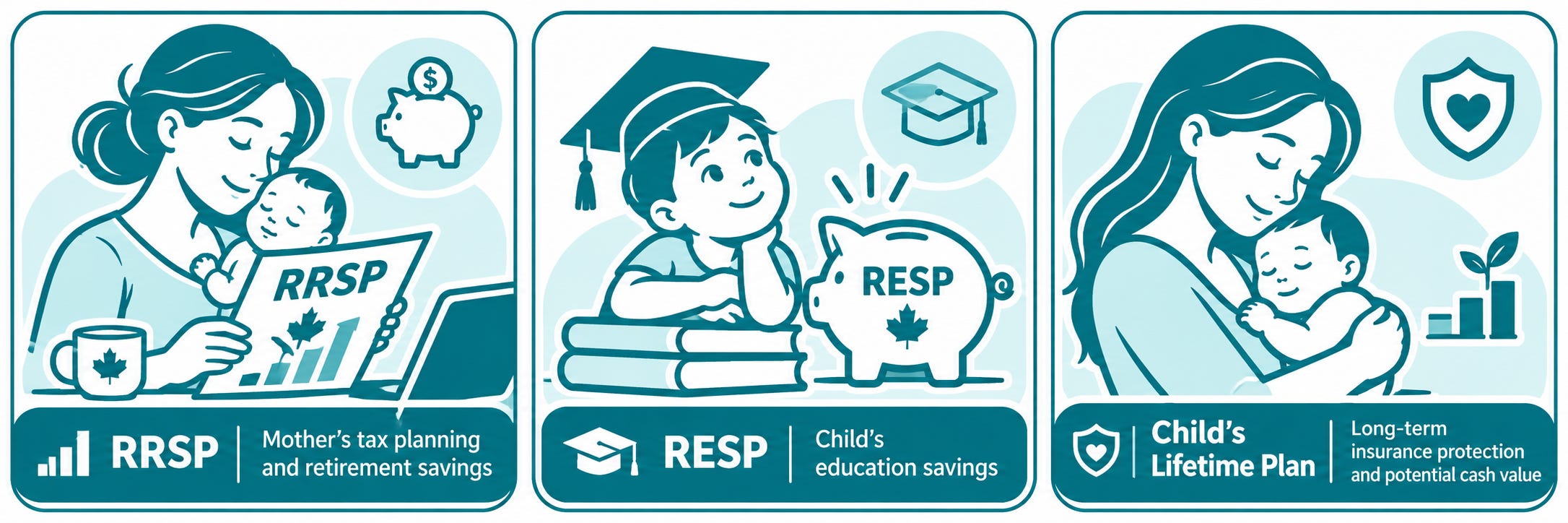
Planning for Your Child’s Tomorrow Starts Today!
While you’re planning your RRSP and retirement savings, don’t forget your little one’s financial future as he/she would soon start to receive the Canada Child Benefit Amounts from the government!
Explore two additional opportunities:
RESP: Start building an education fund and take advantage of available government grants. Last date to get all the Government Grants for the year is 31st December. But don’t delay the RESP application till the last moment as most Financial Institutions are working with less staff during the month of December due to holidays and your application may take longer to be issued.
Child’s Lifetime Plan: Consider lifelong insurance protection and potential cash value growth.
Because the best time to plan for your child’s future is when their journey is just beginning!
Connect with me to explore the right financial solutions for your growing family.