


For the 2027 tax year, the federal government has adjusted income tax thresholds to account for inflation. The federal tax rates remain unchanged, but the income levels at which higher tax rates apply have increased.
The maximum federal Basic Personal Amount (BPA) has also increased to $16,879, providing additional tax relief to eligible taxpayers.
Whether you are an employee, self-employed professional, freelancer, Uber or delivery driver, investor or business owner, understanding these changes can help you plan your finances more effectively.
Let’s look at the 2027 Canadian income tax brackets, federal and provincial tax rates, tax credits and important changes you should know.
1. Understanding Canada’s Income Tax System
Canada follows a progressive income tax system. This means that your income is divided into different tax brackets, and each portion of your taxable income is taxed at a different rate.
Canada has two levels of personal income tax:
Federal income tax: Collected by the Government of Canada.
Provincial or territorial income tax: Collected by the province or territory where you reside.
Your combined income tax liability is generally the total of your federal and provincial or territorial income taxes, after applicable credits, deductions and adjustments.
Important: Moving into a higher tax bracket does not mean that all your income is taxed at the higher rate. Only the portion of income falling within that particular bracket is taxed at that rate.
2. Federal Income Tax Brackets for 2027
The federal government has increased the income thresholds by 2.6% for 2027 to reflect inflation.
The five federal income tax rates remain unchanged at 14%, 20.5%, 26%, 29% and 33%.
2027 federal tax rates

All amounts are in Canadian dollars. Each rate applies only to the income within its respective bracket.
Comparison: 2026 vs. 2027 Federal Tax Brackets

The increase in income thresholds means that more of your income can be taxed at the lower federal rates in 2027 compared with 2026.
3. How Much Federal Income Tax Will You Pay in 2027?
Let’s consider an example of an individual earning $80,000 in taxable income in 2027.
The calculation works as follows:
Income portion

Therefore, the federal income tax before applicable tax credits is approximately $12,497.14.
Your actual federal tax payable will generally be lower after eligible non-refundable tax credits, including the Basic Personal Amount.
Provincial income tax, CPP and EI deductions are calculated separately.
4. What Is the Basic Personal Amount (BPA) for 2027?
The Basic Personal Amount is one of the most important federal non-refundable tax credits available to individual taxpayers in Canada.
It allows eligible individuals to earn a certain amount of income before paying federal income tax on that amount through the basic personal tax credit.
For 2027, the maximum federal Basic Personal Amount increases to $16,879 from $16,452 in 2026.

Most taxpayers qualify for the maximum amount.
For higher-income taxpayers, the additional BPA is gradually reduced as net income increases.
At the 2027 federal rate of 14%, the maximum BPA of $16,879 represents a federal tax credit of up to $2,363.06.
This is a non-refundable tax credit, meaning it reduces the federal income tax payable but cannot generally create a tax refund by itself.
5. Provincial Income Tax Brackets for 2027
In addition to federal income tax, Canadians must pay provincial or territorial income tax.
The provincial tax rates and income thresholds vary depending on where you reside.
Here is a summary of the 2027 provincial and territorial income tax brackets.
Provincial and Territorial Tax Rates
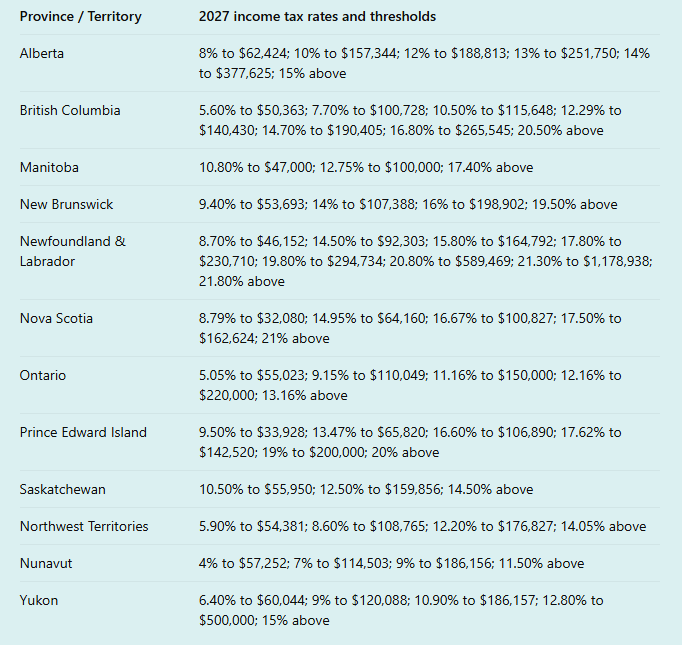
These are provincial and territorial marginal rates before applicable credits, surtaxes, premiums and other adjustments. Québec’s 2027 provincial schedule should be checked separately with Revenu Québec.
Special Note for Ontario Residents
Ontario has five provincial income tax brackets for 2027.

Ontario residents should also be aware of:
Ontario surtax, which applies when provincial tax exceeds specified thresholds.
Ontario Health Premium, which is calculated separately based on taxable income.
Ontario non-refundable tax credits and other eligible deductions.
Consequently, your actual Ontario tax liability may be higher than a simple calculation using the provincial marginal tax rates.
6. What Is Your Combined Federal and Ontario Marginal Tax Rate?
For Ontario residents, federal and provincial income tax rates are combined to determine the marginal income tax rate.
The following table illustrates the combined rates before considering the effect of Ontario surtax and other applicable adjustments.
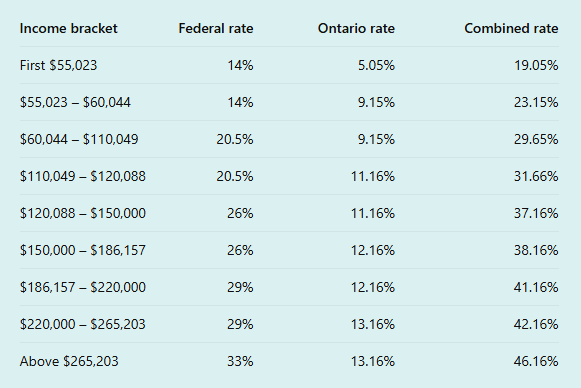
Important: These are illustrative combined statutory marginal rates. Ontario surtax can increase the effective marginal rate at higher income levels. The Ontario Health Premium may also affect the overall tax burden.
7. Important Federal Tax Credits and Amounts for 2027
Apart from changes to income tax brackets, several federal tax credits and deductions are also adjusted for 2027.

Canada Employment Amount
Employees earning employment income may qualify for the Canada Employment Amount.
For 2027, the maximum amount increases to $1,540.
At the federal tax rate of 14%, this represents a maximum federal tax reduction of $215.60.
This credit is generally not available against self-employment or investment income.
RRSP Contribution Limit
The annual RRSP dollar limit increases to $35,390 for 2027.
However, your personal RRSP contribution room depends on your previous year’s earned income, unused contribution room and applicable pension adjustments.
The annual dollar limit is not necessarily the amount you can contribute.
8. Changes to CPP and EI Contributions in 2027
Income tax is not the only deduction affecting your take-home pay.
Employees and employers must also account for Canada Pension Plan (CPP) contributions and Employment Insurance (EI) premiums.
The following changes apply outside Québec.
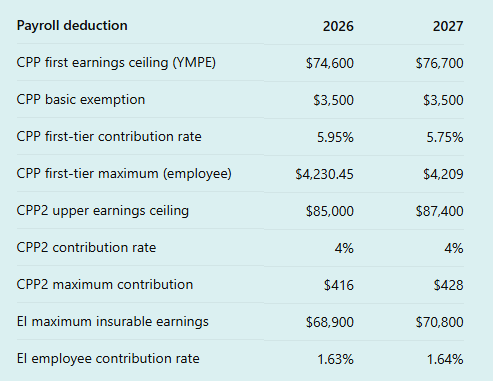
CPP and EI changes can affect your net pay even if your gross salary remains unchanged.
Self-employed individuals generally pay both the employee and employer portions of CPP contributions, subject to applicable maximums. EI participation for self-employed individuals is generally voluntary and limited to special benefits.
Québec has separate QPP and provincial payroll deduction arrangements.
9. How Can You Reduce Your Income Tax in 2027?
Understanding tax brackets is only the first step. Proper tax planning can help you make better financial decisions and potentially reduce your overall tax liability.
Here are some strategies worth considering.
1. Maximize your RRSP contributions
RRSP contributions can reduce your taxable income, potentially bringing you into a lower marginal tax bracket. Consider contributing strategically based on your current and expected future income.
2. Take advantage of your TFSA
Investment income and eligible withdrawals from a Tax-Free Savings Account are generally tax-free. Although TFSA contributions do not provide an income tax deduction, they can be an effective long-term wealth-building strategy.
3. Consider the First Home Savings Account (FHSA)
Eligible first-time home buyers can benefit from tax-deductible FHSA contributions and tax-free qualifying withdrawals.
4. Review eligible employment and business expenses
Self-employed individuals and business owners should maintain proper records of eligible business expenses. Expenses incurred to earn business income may be deductible when they meet CRA requirements.
5. Plan your investment income
Interest, dividends and capital gains may receive different tax treatment. Understanding the tax implications before selling investments or withdrawing funds can help with tax planning.
6. Review income splitting and family tax planning
Where permitted under Canadian tax rules, certain pension income arrangements, spousal RRSP contributions and family tax credits may help optimize household finances.
Income attribution rules and eligibility conditions must be considered before implementing these strategies.
7. Review your insurance and retirement planning
Life insurance, disability insurance and critical illness coverage can form part of a broader financial protection strategy. Certain insurance arrangements may also have tax implications, particularly for business owners.
The appropriate strategy depends on your personal circumstances, business structure and financial objectives.
10. When Will the 2027 Income Tax Brackets Apply?
One common source of confusion is the difference between the tax year and the year in which you file your tax return.
Here is how the timing works:

Important: If you are filing your personal income tax return in spring 2027, you will generally use the 2026 federal and provincial income tax brackets.
The 2027 tax brackets apply to income earned starting January 1, 2027, and will generally be used when filing your 2027 income tax return in 2028.
11. Frequently Asked Questions About Canadian Income Tax Brackets in 2027
Q1. What is the lowest federal income tax rate in Canada for 2027?
The lowest federal income tax rate is 14%, applicable to the first $60,044 of taxable income.
Q2. What is the highest federal income tax rate in 2027?
The highest federal income tax rate is 33%, applicable to taxable income exceeding $265,203.
Q3. Has the federal income tax rate increased in 2027?
No. The five federal rates remain unchanged. However, the income thresholds have increased by 2.6% to account for inflation.
Q4. What is the Basic Personal Amount for 2027?
The maximum federal Basic Personal Amount is $16,879. The minimum is $15,214 for higher-income taxpayers.
Q5. Does earning more money mean paying more tax on all my income?
No. Canada has a progressive tax system. Only the portion of income falling within a higher tax bracket is taxed at the higher marginal rate.
Q6. Which province has the lowest income tax in Canada?
There is no single answer for every income level. Provincial tax rates, thresholds, tax credits and surtaxes differ. Alberta, for example, has a lower starting provincial rate than Ontario, but the overall tax comparison depends on income and personal circumstances.
Q7. Do the 2027 tax brackets apply to my 2026 tax return?
No. A return filed in 2027 for income earned during 2026 generally uses the 2026 tax brackets.
Q8. Are self-employed individuals taxed differently?
Self-employed individuals generally use the same federal and provincial personal income tax brackets. However, they may deduct eligible business expenses and are generally responsible for both portions of CPP contributions.
Case Study 1: Annual Employment Income – $50,000
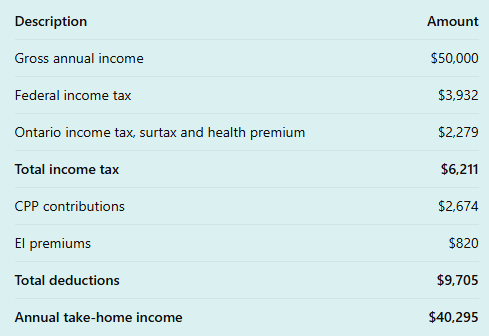
Monthly take-home income = $3,358
Approximately $775 per week
Gross monthly income $4,167
Average income tax rate 12.42%
Observation: An individual earning $50,000 pays approximately $6,211 in income tax. CPP and EI contributions bring total statutory deductions to approximately $9,705.
Case Study 2: Annual Employment Income – $100,000
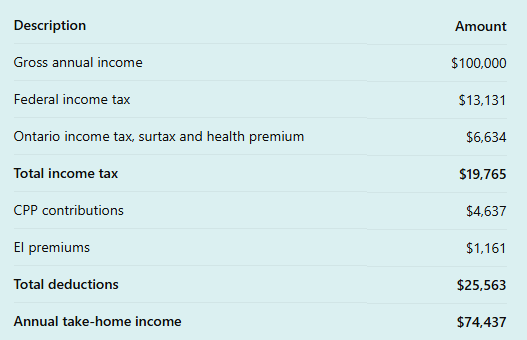
Monthly take-home income $6,203
Gross monthly income $8,333
Average income tax rate 19.77%
Observation: Although the salary has doubled compared with Case Study 1, the take-home income has not doubled. This is because income above certain thresholds is taxed at higher marginal rates.
Case Study 3: Annual Employment Income – $150,000
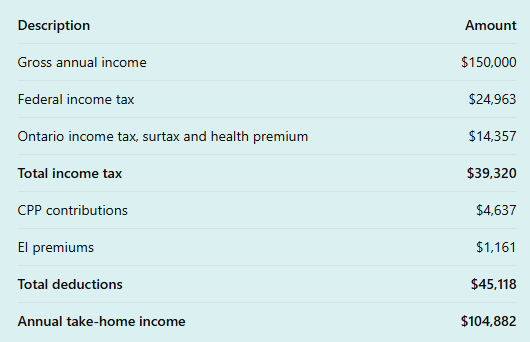
Monthly take-home income $8,740
Gross monthly income $12,500
Average income tax rate 26.21%
Observation: At this income level, the individual pays approximately $39,320 in income tax alone. More than one-quarter of gross employment income goes towards income tax.
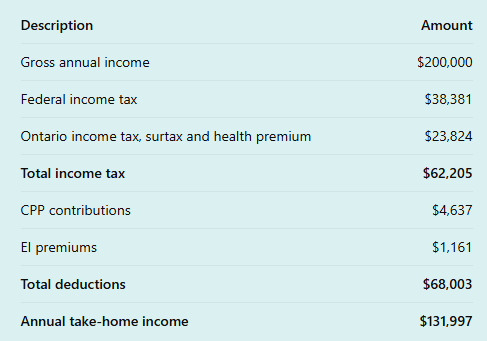
Case Study 4: Annual Employment Income – $200,000
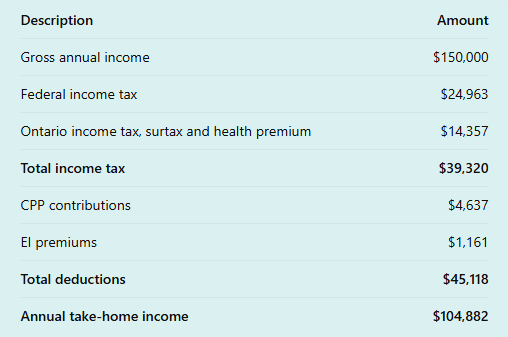
Monthly take-home income $11,000
Gross monthly income $16,667
Average income tax rate 31.10%
Observation: At $200,000, the individual pays approximately $62,205 in income tax. Ontario surtax and the federal tax structure contribute to a higher overall tax burden.
Case Study 5: Annual Employment Income – $250,000
Monthly take-home income $13,105
Gross monthly income $20,833
Average income tax rate 34.77%
Observation: An individual earning $250,000 pays approximately $86,937 in income tax. This represents almost 35% of their gross employment income, before CPP and EI deductions.
Case Study 6: Annual Employment Income – $300,000
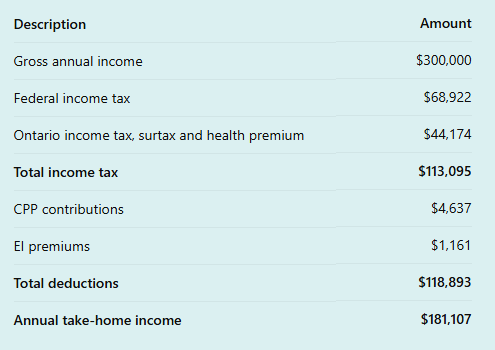
Monthly take-home income $15,092
Gross monthly income $25,000
Average income tax rate 37.70%
Observation: At $300,000, the individual pays more than $113,000 in income tax. The combined marginal tax rate on additional ordinary employment income at this level is approximately 53.53%.
This means that for every additional $1,000 of taxable employment income, approximately $535 could go towards federal and Ontario income tax, assuming the individual remains in the same tax bracket.
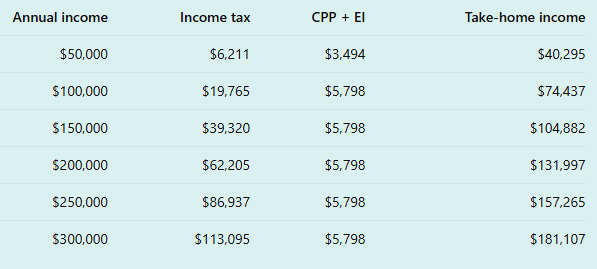
Comparison of All Six Case Studies
Here is a consolidated comparison of the six income levels.
How much of your income goes towards income tax?
Estimated federal and Ontario income tax, including Ontario Health Premium and surtax, as a percentage of gross employment income.
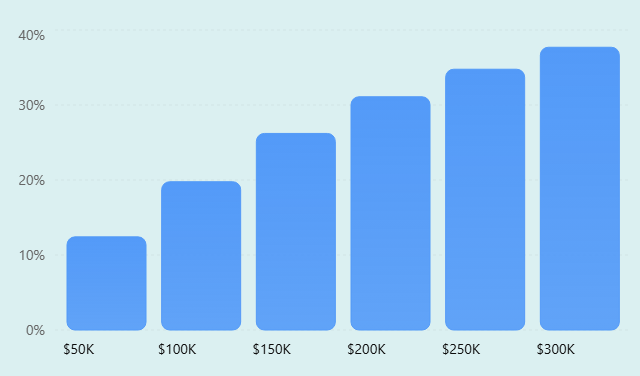
The chart illustrates how the average income tax burden increases as annual income rises.
Important Tax Planning Considerations for High-Income Earners
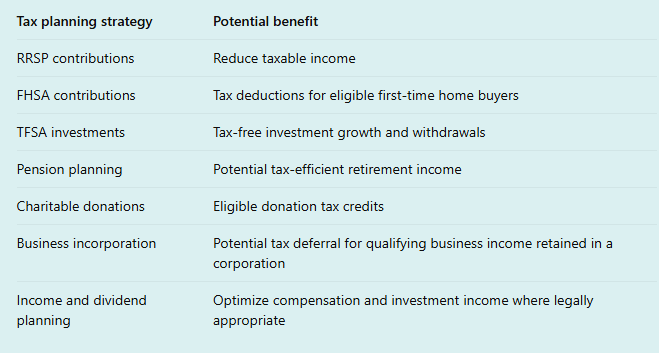
When an individual’s income reaches $150,000, $200,000 or $250,000 and above, tax planning becomes increasingly important.
Here are some strategies worth considering:
Finally: Prepare for the 2027 Tax Year
Earning a higher income does not necessarily mean that you should simply accept a higher tax bill without planning.
A person earning $250,000 may pay approximately $86,937 in income tax, while someone earning $100,000 may pay approximately $19,765.
The difference demonstrates why understanding marginal tax rates, tax credits, deductions, retirement savings and business structures is important.
The objective of tax planning is not simply to earn more money. It is to retain more of what you earn while building long-term financial security.
The 2027 Canadian income tax changes provide some additional relief through higher federal tax thresholds and an increased Basic Personal Amount.
Although the federal tax rates remain unchanged, inflation adjustments can make a meaningful difference to the amount of income taxed at each rate.
For individuals, employees, freelancers, self-employed professionals and business owners, understanding these changes is important for effective financial and tax planning.
Rather than waiting until tax season, consider reviewing your income, expenses, RRSP contributions, TFSA investments and retirement plans in advance.
A little tax planning throughout the year can make a significant difference when it is time to file your return.